Things to do · Ancient Sligo
Heritage & Ancient Sligo
Ancient tombs, cairns, Céide Fields and scenic landscapes — some of the oldest monuments in Europe stand within an easy drive of the house.
c. 4000 BC
Creevykeel Court Tomb, Neolithic period
5,000 years
of farmed landscape at Céide Fields
1610
Parke’s Castle completed on Lough Gill
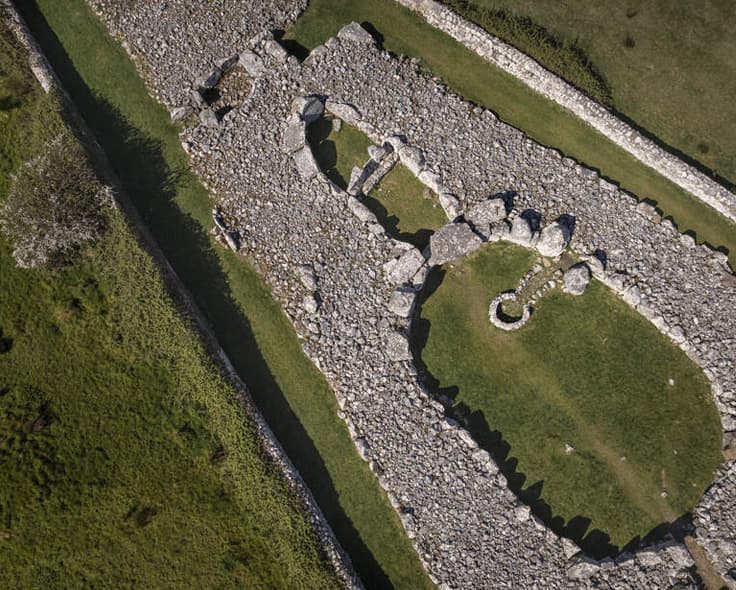
Creevykeel Court Tomb
One of the finest full-court
tombs in Ireland
This monument is situated at the foothills of Tievebaun Mountain, near the sea at Mullaghmore. Dating from the Neolithic period (c. 4000 – 2500 BC) it consists of a wedge-shaped cairn about 50m long, incorporating at its eastern end an oval-shaped court — among the largest of its type in Ireland, measuring 15m long by 9m wide. From the court is the entrance to the burial gallery, divided by upright stones into two chambers and originally covered by a corbelled roof.
Knocknarea
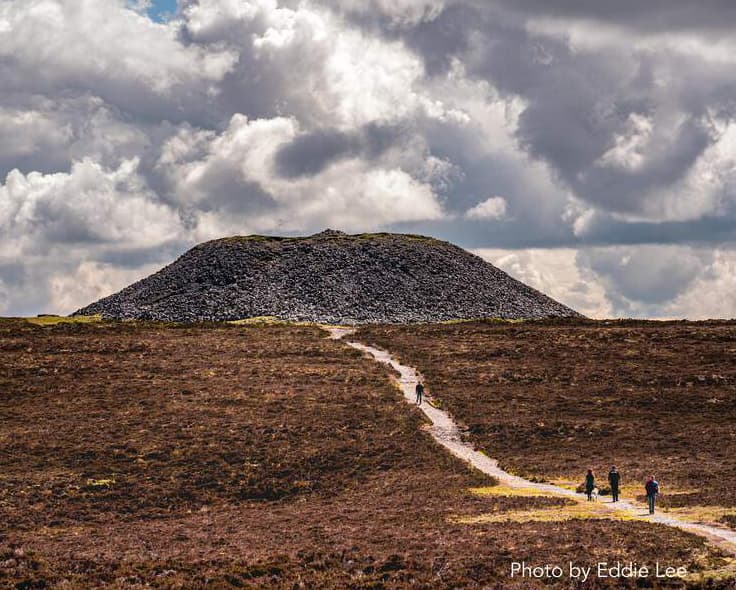
Queen Maeve’s Cairn
and The Glen
Queen Maeve’s Cairn, perched on the summit of Knocknarea, is one of the most impressive megalithic monuments remaining in Ireland — the resting place of the legendary Queen Maeve of Connaught. Legend tells us she was buried standing upright within the chamber, with her armour on and facing her ancient enemies in Ulster. Six more neolithic monuments and the foundations of some 28 neolithic houses share the mountain with her.
Below the summit hides The Glen — a chasm carved deep into the limestone for almost a mile, its 60 ft walls draped with vines like a walkway to another world. The entrance is easy to miss and the floor often muddy; unless the weather has been dry for weeks, wellingtons or stout boots are essential.
Further afield
Céide Fields, the Hill of the Fairies and a plantation castle
Céide Fields
Beneath the wild boglands of North Mayo lies Céide Fields — the world’s most extensive Stone Age monument, featuring 5,000-year-old field systems, dwellings and megalithic tombs. At the pyramid-shaped glass centre, visitors can explore exhibitions — including a 4,300-year-old Scots Pine tree — and take in stunning sea views from the panoramic platforms.
Knocknashee
Knocknashee, the ‘Hill of the Fairies’, is one of Ireland’s largest Bronze Age fortified hilltop forts, stretching 700×320 metres across a table-top plateau — called “a place apart” and “one of the great European hill-forts” by archaeologist Michael Gibbons. Take the guided walk in the company of John Barrett of Wild Wet Adventures (tel 086-7222750), from the ramparts to the Stone Age summit tomb-cairns.
Parkes Castle
Rising three storeys tall in an idyllic setting on the banks of Lough Gill, Parke’s Castle is a plantation era castle, completed in 1610 by Roger Parke on the site of a fifteenth-century O’Rourke tower house. Open approx 21st April – 28th Sept, 10.00 – 18.00, last admission 45 minutes before closing. Guided tours available on request (maximum 25 people, 40 minutes).
Keep exploring
More things to do
Make a Plan
Stay at Temple House
Sleep inside the story — the house looks over a Knights Templar castle of its own, with Sligo’s ancient tombs, cairns and castles all within an hour’s drive.