Things to do · Culture & heritage
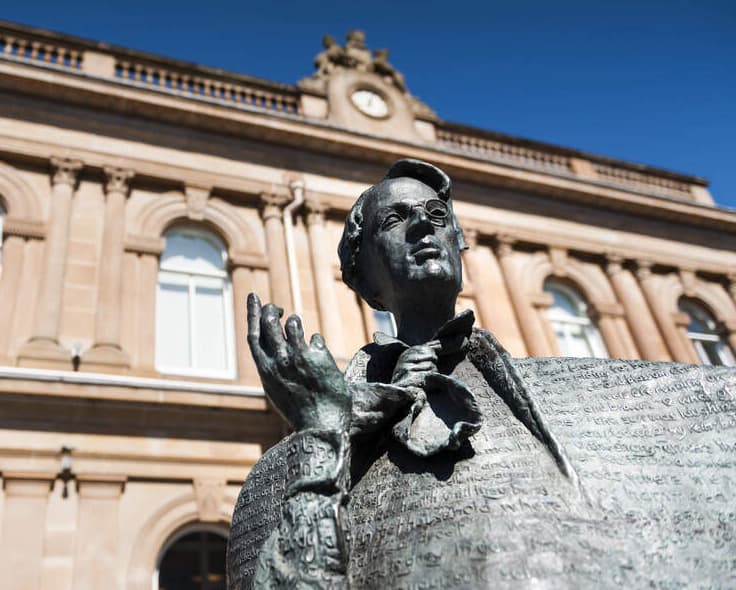
W.B. Yeats Country
W.B. Yeats drew inspiration from County Sligo all his life — a post-Ice Age drama pitted with blue lakes, megalithic remains of early man and, at every turn, a line from William Butler Yeats that captures forever the magic of the place.
Touring with Damien Brennan
The Land of Heart’s Desire
His brother, Jack B. Yeats, drew on the same landscape in line drawings and later impressionist oils, saying that “everything I paint has something of Sligo in it”. They wrote and painted in the late 1800s, but a great deal of it can still be seen now as then.
Damien Brennan knows all of its history, all of its poetry, and delights in taking visitors along with him on a tour of discovery around the Land of Heart’s Desire, as Yeats referred to Sligo — coach groups, small bus tours and private individuals, in your vehicle or his comfortable car.
35 minutes north
Lissadell House
Lissadell is renowned as the childhood home of Constance Markievicz — a leader of the 1916 Rising, the first woman elected to Dáil Éireann and the first female minister in a modern European democracy — and of her sister, the poet and suffragist Eva Gore-Booth. Yeats, a close friend of the sisters, stayed at Lissadell in the 1890s and immortalised them in verse:
“The light of evening, Lissadell,
Two girls in silk kimonos, both
Beautiful, one a gazelle.”
Today Lissadell House and Gardens is home to Edward Walsh and Constance Cassidy, whose extensive restoration has revived its historic charm. It remains one of Sligo’s must-see attractions — just 35 minutes north of Temple House.
The Model Arts & Niland Centre
This award-winning building in Sligo town is home to one of the most notable public art collections in Ireland, featuring one of the largest public holdings of work by Jack Butler Yeats in existence, alongside major Irish and international contemporary art — www.themodel.ie.
Drumcliffe Church
Drumcliffe, set against the striking backdrop of Benbulben, is best known as the final resting place of W.B. Yeats. His grave in the churchyard is marked with a simple headstone bearing his self-penned epitaph — “Cast a cold eye on life, on death, horseman, pass by.” — together with his instruction that the grave consist of “no marble, no conventional phrase”.
The graveyard also contains a high cross, and nearby is the site of a 6th-century monastery. A coffee shop and craft shop on site offer home baking and quality crafts — visit his grave at Drumcliffe church.

Keep exploring
More things to do
Make a Plan
Stay at Temple House
Ten bedrooms in the heart of Yeats Country — Drumcliffe, Lissadell and Lough Gill are all within easy reach of the house.